Current project / Cooperative game
Wildfire ResponseMake the next order count.
A cooperative browser game about deciding what to protect when water, money and crew time are limited.
I shaped the product direction and brought playtest feedback into the map, controls and consequences. I work with Codex on implementation and iteration.
See the decisions- My contribution
- Product direction and playtest feedback
- Made with
- Codex-assisted development and game art
- The experience
- Shared map · timed orders · team consequences
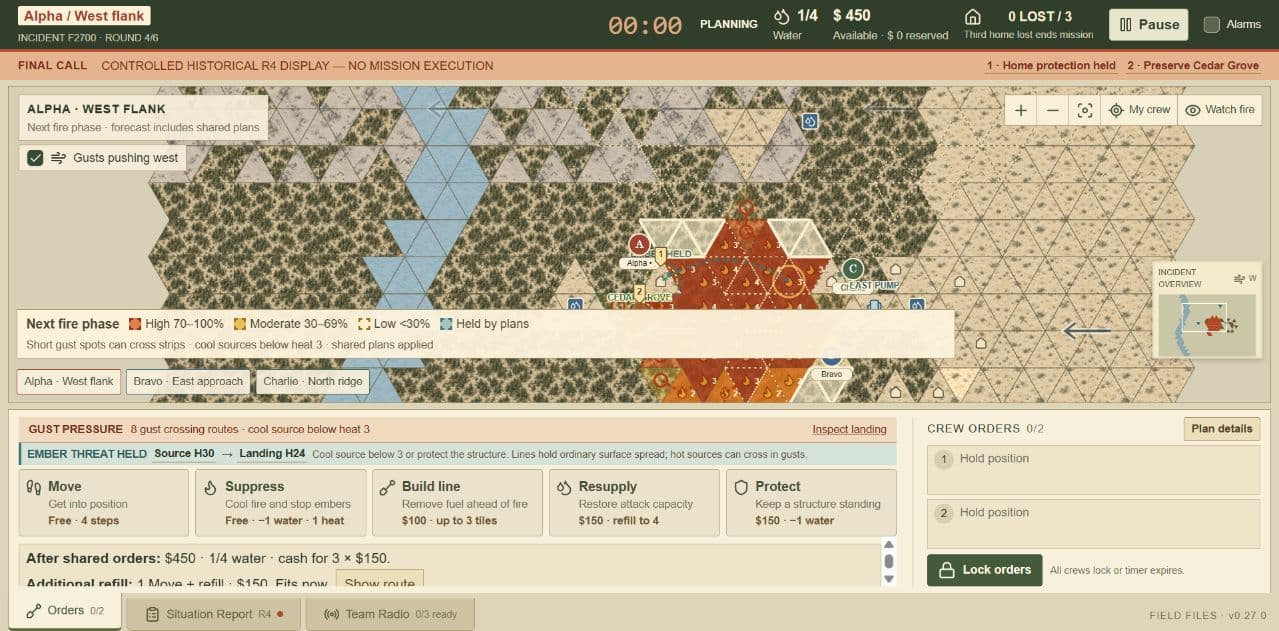
Actual v0.27 interface displaying a historical development fixture. The room code is synthetic and gameplay was disabled for this capture. Terrain art is AI-assisted.
- See what you have
- Water and shared spending stay beside the decisions that use them.
- Read what might happen
- Wind, heat and queued plans inform the next-phase forecast.
- Coordinate the response
- Crew plans and Team Radio share intentions before orders resolve.
Product decisions / From my first playtest
Make the choices visible.
My first-playtest feedback led to a larger map, distinct crew approaches, connected fire lines and location-based resupply.
The important detail was the cost of a choice. An action needed a clear purpose, price and projected effect before it entered the queue. Camera controls, visible sectors and supply points made the wider map easier to inspect.
The resulting loop keeps the map in view while Orders, Situation Report and Team Radio handle different jobs. Players prepare a plan, see its costs and expected effects, and then watch crew and fire phases resolve.
A design correction
A line should help without becoming the answer to everything.
In the early rules, a line permanently blocked spread while partial suppression did not reduce its probability. Iteration gave cooling immediate value and introduced forecasted ember crossings.
That turns one repeated action into several different responses: cool the source, defend a structure, or remove fuel at a landing. These are disclosed game abstractions, not calibrated wildfire predictions.
Explore the tradeoffs
01 Cool the source
Suppression spends water to lower heat. Lower heat reduces outgoing danger before the fire is fully extinguished.
02 Build a line
Clearing open fuel holds ordinary surface spread. A hot source in gusts can send embers across a cleared strip; the forecast exposes that route.
03 Protect a place
Protection buys a home or water pump time. Its limited window makes timing, travel and the next order part of the decision.
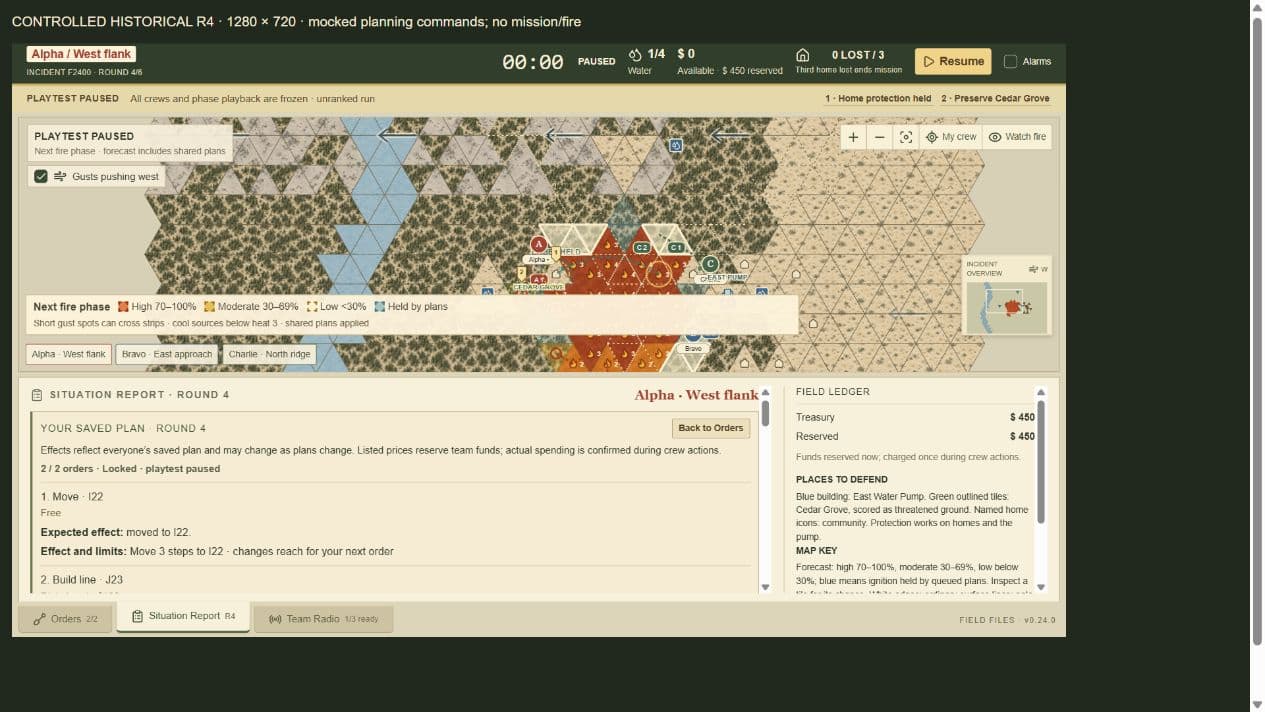
v0.24 saved-plan interface in a synthetic, paused development fixture. The surrounding test frame is retained. This shows the interface, not an independent player session.
The work now
A playable project, still evolving.
The build brings together the map, five crew actions, a two-order queue, shared resources, fire phases, radio and a team result. The next useful evidence comes from people playing together: what they understand, how they coordinate and whether the choices remain interesting.
Independent human playtests and physical-device experience remain open. Network recovery and wider role balance also need further work. This is a game, not emergency guidance.
About the evidence and collaboration
The project changelog records my first-playtest improvements. The accepted goal sets the product direction; Codex carries out AI-assisted development within it. Screenshots show version-labelled development fixtures. They do not establish player satisfaction, independent multiplayer testing or real-world fire accuracy.
Read the media provenance record